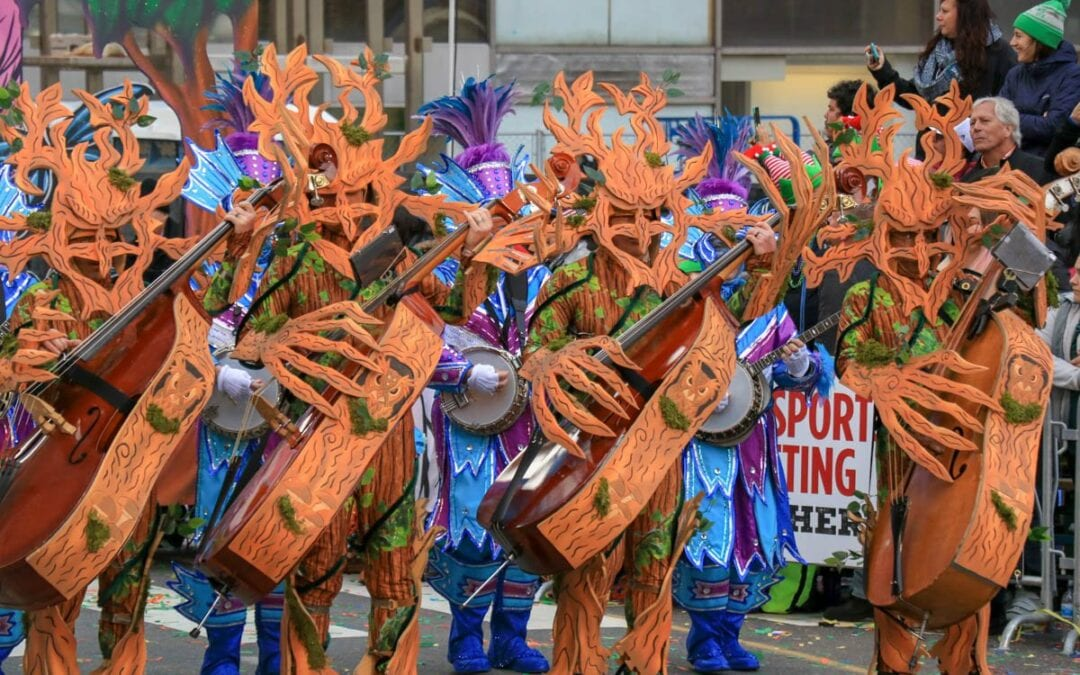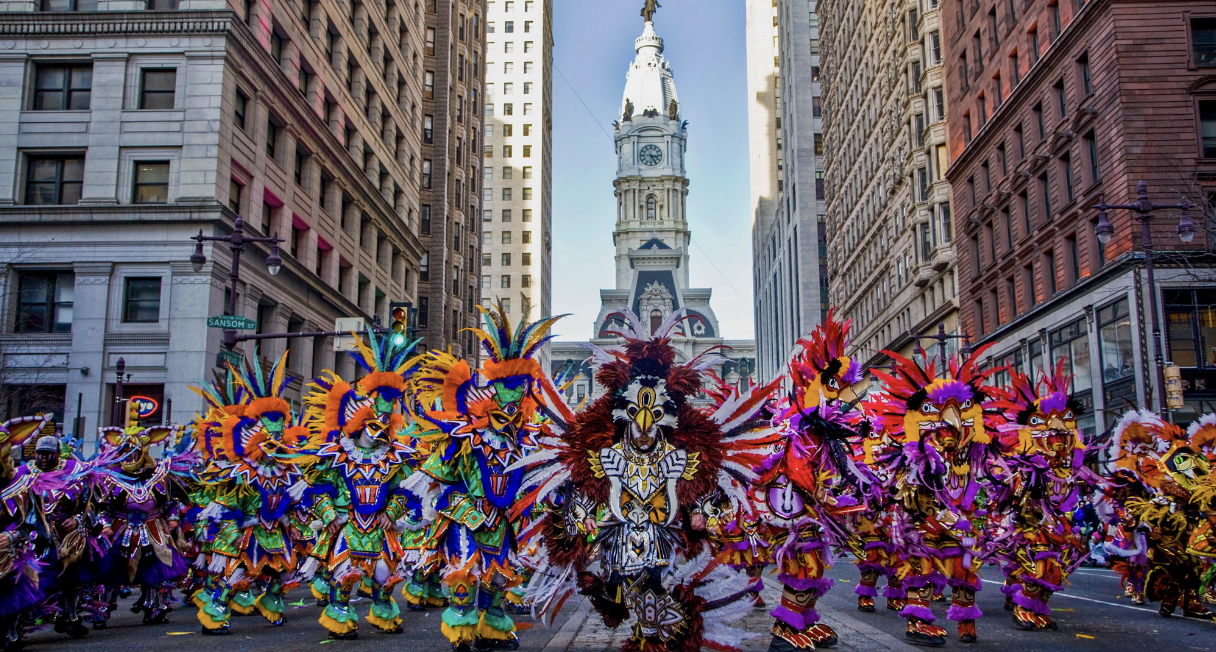

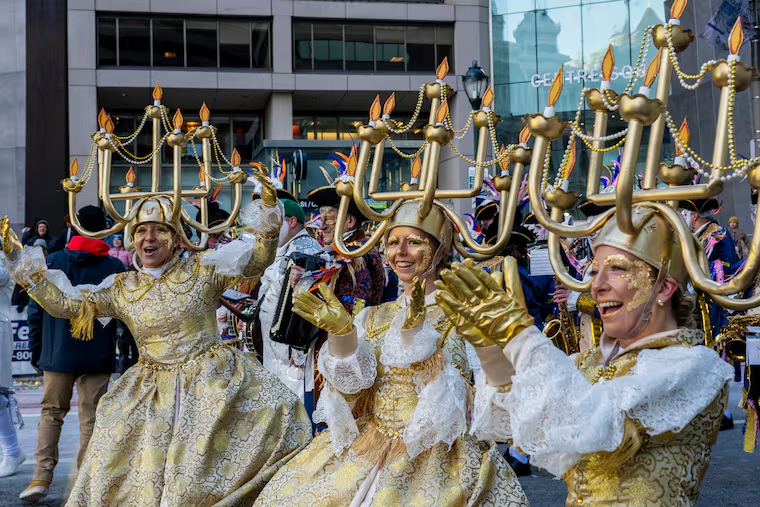
Every year on January 1, while most of the world is still recovering from New Year’s Eve, Philadelphia’s main thoroughfare—Broad Street—explodes with thousands of colorful feathers, glitz, the clatter of hundreds of banjos, and eccentric dancing. More than 10,000 marchers dressed in dazzling, often whimsical costumes take to the street for a parade that lasts from dawn until late evening.
This is the Mummers Parade—the oldest continuous folk carnival in the United States, officially established in 1901. Yet for Philadelphia, it is far more than just a colorful spectacle. It is a working-class subculture passed down through generations and a pure concentrate of local identity. Read more about this spectacular event at iphiladelphia.net.
Roots of the Tradition: A Melting Pot of Folk Holidays
The term “mummer” traces its roots back to the High German word mummen (to disguise oneself or hide one’s face) and the Middle English term mummery (a masked street performance). The tradition of celebrating the New Year with noisy, carnival-style festivities in masks and extravagant costumes arrived on the shores of Delaware Bay in the 17th and 18th centuries alongside the first waves of European settlers.
Modern Mummery evolved from a unique blend of several distinct cultural traditions.
- Scandinavian Yule. Swedish and Finnish settlers brought the custom of celebrating the winter solstice by going door-to-door wearing fur-outward coats and animal masks, shouting loudly to ward off evil spirits.
- British Mumming Plays. English and Irish immigrants introduced the tradition of Christmas street pantomimes and comical plays about St. George. Masked revelers roamed the neighborhoods, demanding food and spirits from homeowners in exchange for witty puns, poems, or songs.
- German Belsnickel. German communities enriched the holiday with “Belsnickel”—a stern winter figure clad in fur and a mask who noisily handed out treats to well-behaved children while threatening troublemakers with switches.
- African American Rhythm and Movement. The influence of African American culture proved decisive for the parade’s musical and choreographic identity. It contributed syncopated exotic rhythms, the famous proud “strutting” movement, and the banjo—which ultimately became the parade’s primary instrumental symbol.
Throughout the 19th century, these scattered, rowdy groups of revelers—known as Chanticleers and Shooters—roamed the New Year’s streets of Philadelphia, firing pistols into the air and causing noisy mayhem. In 1901, city officials decided to officially organize and regulate the folk carnival. Championed by the first official organizer, Bartolomeo Shea, the loose street gangs were consolidated into a single centralized parade with clear guidelines and substantial cash prizes for the best costumes and performances.
Anatomy of the Parade: 5 Unique Divisions
Today’s Mummers Parade is a well-structured hierarchy divided into five primary divisions, each with its own distinct personality, rules, and visual style.
| Division | Performance Features | Key Attributes / Instruments |
| Comics | Satirical performances mocking current political events, pop culture, and local urban issues. | Humorous signs, spoof costumes, and themed pushcarts. |
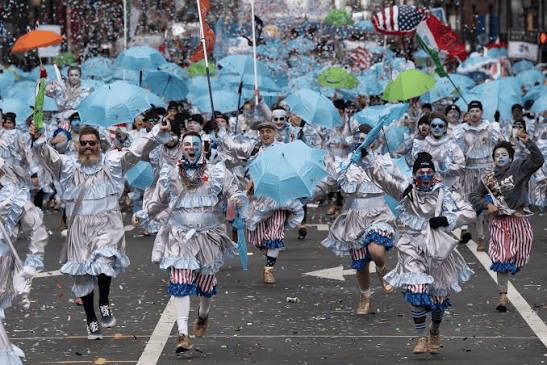
| Wench Brigades | Men perform in traditional Victorian-era women’s dresses, bloomers, and bonnets. | Colorful parasols and the signature “strut” step. |
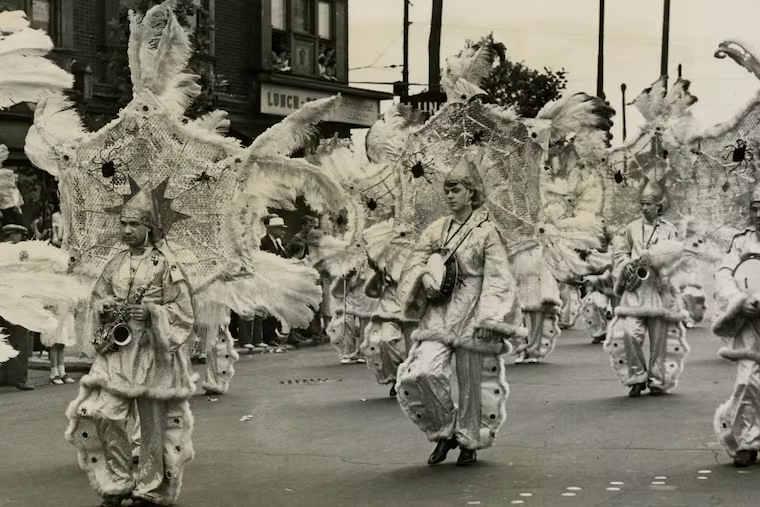
| Fancy | Elaborate, monumental costumes. Participants wear massive frame constructions with feathers weighing up to 90 lbs (40 kg). | Giant capes, trails, ostrich and peacock feathers. |
| String Bands | The musical and visual highlight of the parade. Strict rule: no brass instruments (such as trumpets or trombones). | Banjos, saxophones, accordions, violins, percussion, and sousaphones. |
| Fancy Brigades | High-tech indoor group performances featuring intricate choreography, theatrical sets, and props. | Theatrical lighting, mobile props, and large-scale choreography. |
The absence of brass instruments like trumpets and trombones is a strict historical standard. The acoustic balance of dozens of banjos and saxophones creates the signature, ringing “Sound of Philadelphia” that cannot be confused with any other marching band in the world.
The “Two Street” Phenomenon and Family Dynasties
Behind the vibrant costumes and feathers lies the rock-solid working-class culture of South Philadelphia, particularly its historic Pennsport neighborhood. Mummery is not professional commercial theater, but a genuine labor of love by everyday locals. In their daily lives, most active participants are construction workers, plumbers, firefighters, police officers, or small business owners.
Preparation for the next January 1st parade begins virtually on January 2nd. Mummer clubs operate year-round, turning parade prep into a way of life for the entire community:
- Financial Independence. Out of their own pockets and through local fundraisers, members raise tens of thousands of dollars for a single 4-minute performance in front of the judges.
- Meticulous Handcrafting. Massive costumes are hand-stitched with beads, sequins, and feathers in South Philly basements, garages, and clubhouses.
- Generational Heritage. The skills to play banjo, design sets, or properly execute the signature mummer strut are passed down through families across four or five generations.
Once the official march down Broad Street ends and the judges cast their scores, the real tradition begins—the legendary unofficial celebration on “Two Street” (2nd Street). All the clubs return to their home turf in Pennsport. The street is completely shut down to traffic, and until late at night, thousands of Mummers join neighbors, families, and friends for a spontaneous, joyous outdoor party.
Controversies and Modern Transformation
Like many long-standing folk traditions, the parade remained deeply conservative for decades and faced its share of public controversies.
- Exclusivity and Gender Barriers. Historically, it was strictly a working-class men’s club. Women were not officially permitted to compete until the 1970s (today, they make up a significant portion of String Bands and Fancy Brigades).
- Racial Legacy. In the 19th and early 20th centuries, comic divisions frequently used blackface. Under pressure from the Civil Rights movement, the city banned blackface at the parade in 1964, though isolated incidents occurred in later years, sparking intense debate.
Today, organizers and Philadelphia city officials actively work to modernize the festival. New inclusive divisions have joined, local diverse community groups are invited to participate, and rules prohibiting offensive or discriminatory humor have been strictly enforced.
The Mummers Parade has survived the Great Depression, world wars, and global pandemics. It stands as a living testament to how ancient mumming customs can adapt to the 21st century while remaining a prime source of pride and a cultural touchstone for Philadelphia.