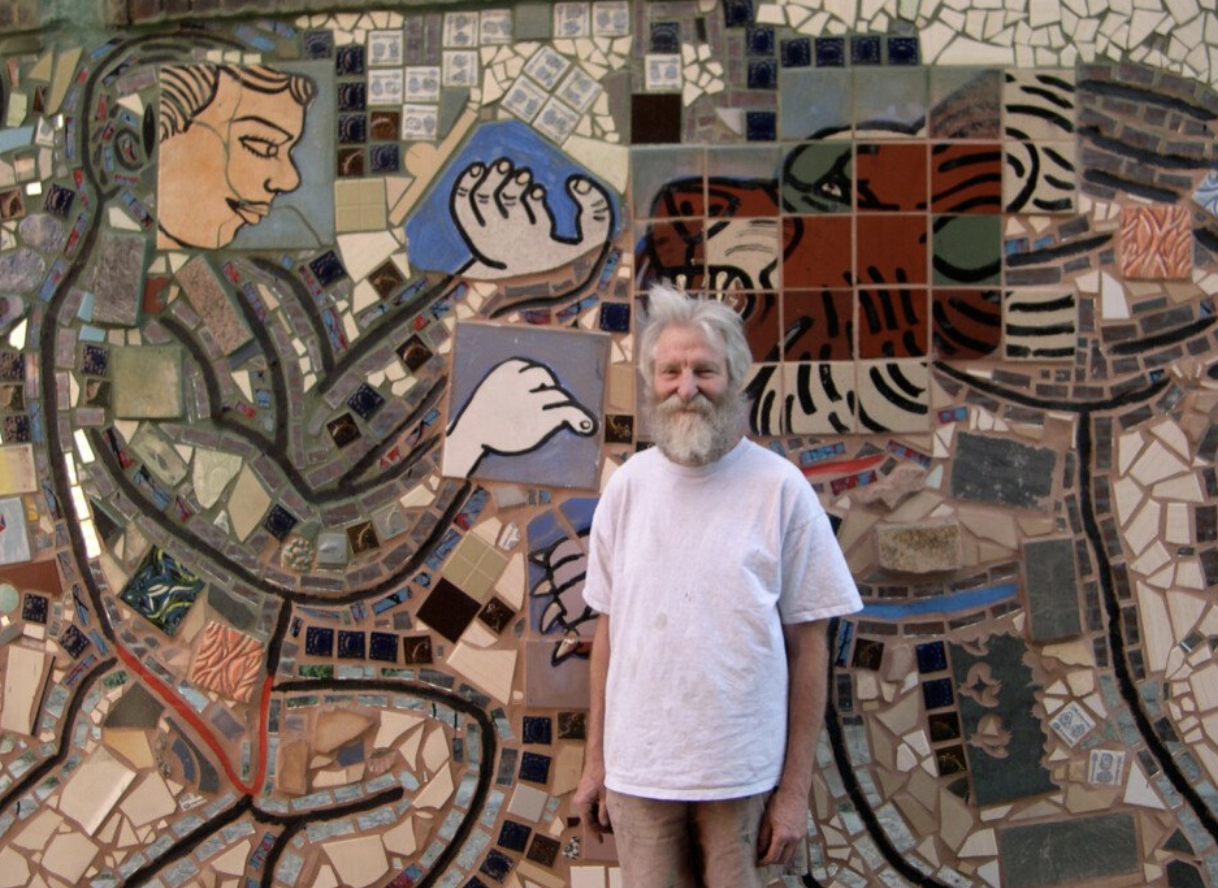

In the late 1960s, Philadelphia’s South Street was on the brink of erasure. City officials planned to demolish several blocks to make way for the Crosstown Expressway. The impending demolition sent property values plummeting, turning the neighborhood into an overlooked urban wasteland. Yet, the dirt-cheap storefronts soon drew in artists, musicians, and free spirits—igniting a cultural movement that came to be known as the “South Street Renaissance.”
In 1968, artist Isaiah Zagar and his wife, Julia, moved to the area. Rather than seeing urban decay in the crumbling facades, Zagar saw an enormous canvas for public art. Below, iphiladelphia.net tells the story of South Street’s vibrant transformation.
The Philosophy of Anarchic Collage: Crafting a Mosaic Labyrinth
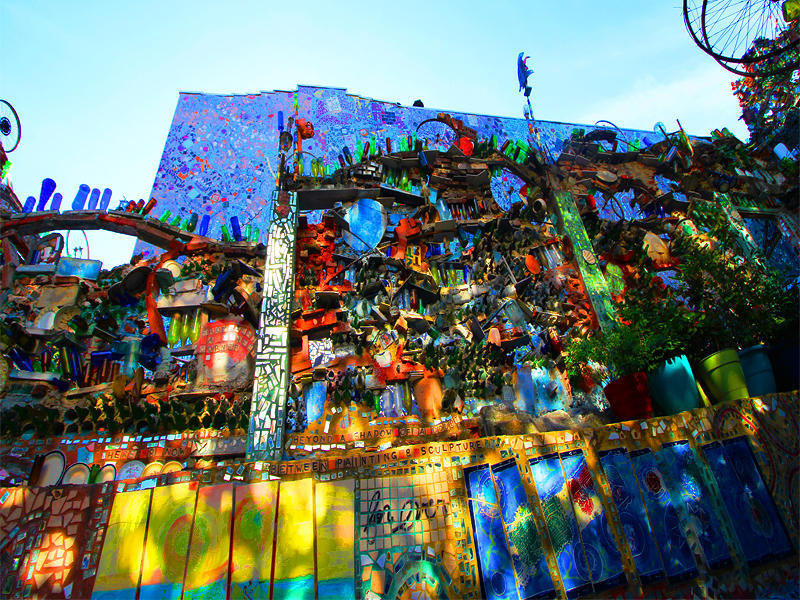
Isaiah Zagar’s work transcends traditional mosaics and conventional street art. It is a raw, three-dimensional anarchic collage. Here, everyday household items, scrap materials, and urban debris merge seamlessly with intimate diary entries, sacred folk motifs, and poignant poetry.
From Household Scraps to Artistic Expression
Zagar turned the concept of recycling and reclaiming materials into his core aesthetic and philosophical manifesto. Embedded into the concrete walls of his sprawling labyrinth are thousands of everyday artifacts discovered on Philadelphia’s streets, salvaged from junkyards, or donated by neighbors.
- Mirror Shards. Reflecting sunlight, street lamps, and passersby, they produce a dynamic kaleidoscopic effect that visually expands narrow alleys and tucked-away courtyards.
- Everyday Ceramics and Glass. Tinted bottles, shattered porcelain, decorative tiles, and assorted metal hardware—from bicycle chains to wheels off vintage roller skates—are set permanently into the mortar.
- Inscribed Messages. Hand-sculpted or etched directly into wet cement, these include lines of classic poetry, quotes from visionary artists, bold political manifestos, and deeply personal confessions from the artist’s journals.
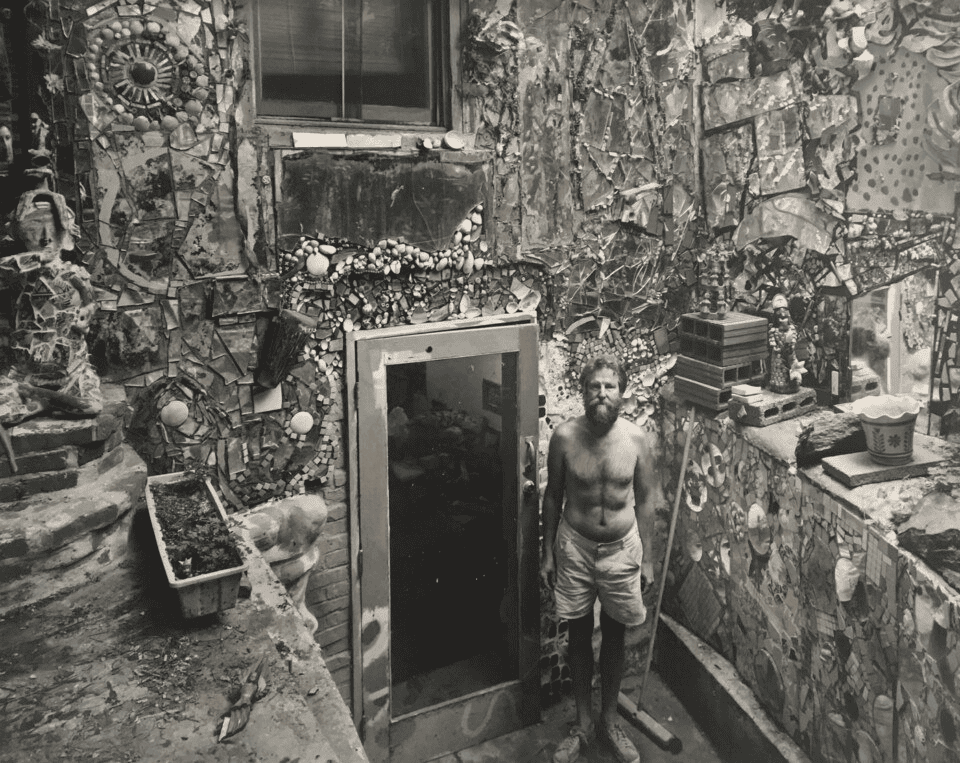
Echoes of Gaudí, Art Brut, and Peruvian Folk Tradition
Zagar’s unmistakable visual signature was shaped by several profound influences. His late-1960s service with the Peace Corps in Peru introduced him to traditional folk crafts and South American ceremonial art. While traveling through Europe, he was captivated by Antoni Gaudí’s architectural masterworks in Barcelona—most notably Park Güell—and by Jean Dubuffet’s raw, anti-academic Art Brut. Closer to home, Simon Rodia’s towering Watts Towers in Los Angeles served as an essential American beacon.
By blending the organic chaos of outsider art with the unyielding permanence of concrete and glass, Isaiah Zagar forged his own distinct vocabulary. His anarchic collage transformed a neglected patch of the city into a living art environment, where every chipped teacup and rusted chain links into a grand anthem celebrating creative freedom.
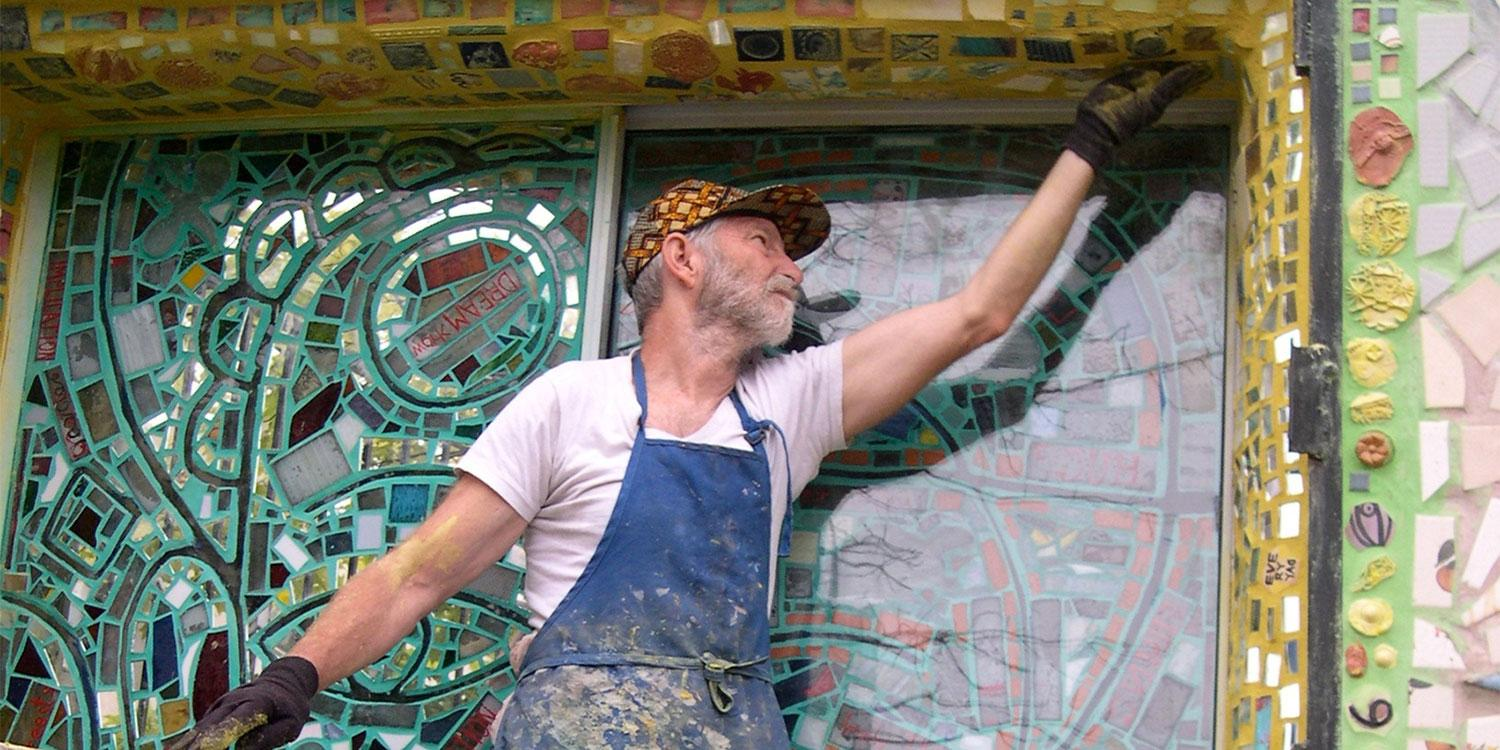
The Anatomy of Magic Gardens: Stepping into a 3D Mosaic
In 1994, Zagar embarked on his most ambitious venture yet, setting his sights on an overgrown vacant lot at 1020–1022 South Street. Over fourteen years of relentless daily labor, he excavated subterranean passages, built curving brick corridors, and painstakingly covered every square inch with vibrant mosaics, turning the vacant lot into a living, breathing sculptural organism.
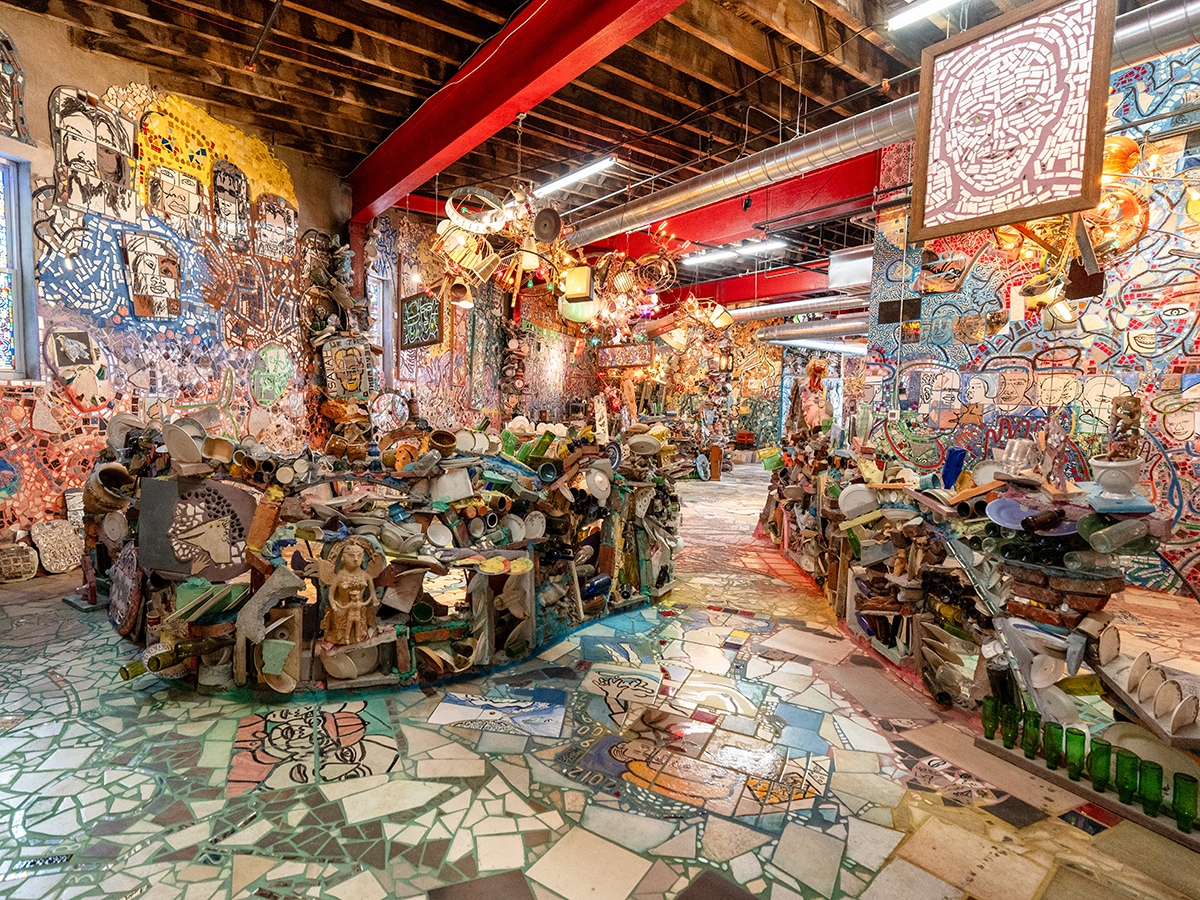
Today, Philadelphia’s Magic Gardens features a two-story indoor gallery and an expansive outdoor labyrinth. Visitors are instantly enveloped by an immersive environment of sunken grottos, elevated catwalks, and winding tunnels. Here, conventional distinctions between sculpture, architecture, landscape design, and painting vanish entirely.
Spatial Layout of the Mosaic Labyrinth
- Lower Level (The Grottos). Cool, subterranean tunnels and cozy alcoves lined with thousands of colorful glass bottles. As daylight filters through the glass, it refracts across the mortar walls in stained-glass hues of emerald, amber, and cobalt.
- Upper Terraces. Walkways and bridges that offer sweeping views across the courtyard maze, as well as towering mosaic murals that Zagar crafted on the facades of neighboring buildings.
- Central Gallery. An indoor exhibition and educational venue showcasing Zagar’s sketches, prints, and mixed-media works alongside rotating exhibits by celebrated outsider and folk artists from around the world.
Philadelphia’s Magic Gardens is far more than an open-air museum; it is an interactive sculptural environment that invites full physical immersion. Navigating its labyrinthine turns feels like an aesthetic meditation, with each corner revealing new tactile textures, hidden allegories, and striking optical illusions.
The Battle for Sacred Ground: How the Community Saved Zagar’s Creation
The story of Philadelphia’s Magic Gardens is not just a testament to artistic perseverance; it stands as one of America’s most striking examples of grassroots activism, community solidarity, and the successful preservation of unconventional cultural heritage against aggressive commercial development.
For decades, Isaiah Zagar crafted his masterpiece on land that was legally owned by a private Boston-based landlord. In 2004, the owner decided to sell the property for redevelopment and gave Zagar an ultimatum: tear down the mosaics immediately or watch them get bulldozed. The threat of losing the site triggered massive public outcry. Local Philadelphians, fellow artists, neighborhood associations, and grassroots activists mobilized under the banner Save the Magic Gardens, launching an energetic awareness and fundraising campaign.
Stages of Salvation and Transformation
- Incorporating as a Non-Profit. Activists organized and registered Philadelphia’s Magic Gardens as a formal non-profit organization to oversee operations and safeguard the site legally.
- Grassroots Land Acquisition. Through community donations, grants from cultural trusts, and private philanthropists, the campaign raised over $300,000, enabling the organization to buy the property outright from the Boston landlord.
- Museum Preservation and Stewardship. The saved landmark was converted into a public museum with educational programming, guided tours, and a dedicated conservation studio tasked with preserving the fragile ceramic and concrete elements.
The community’s triumph proved that cultural heritage and local pride can hold their own against speculative real estate pressures. Thanks to the solidarity of Philadelphia residents, Zagar’s mosaic wonderland survives as a living monument to creative expression and civic resilience.
Legacy and Cultural Identity: Rewriting Philadelphia’s DNA
Isaiah Zagar achieved the extraordinary: he reshaped the visual vernacular and architectural identity of an entire metropolis. Through decades of relentless dedication, he helped earn Philadelphia the undisputed reputation as a premier world capital of public mosaics. More than 200 expansive public mosaic murals embellish exterior walls, firebreaks, and alley fences across the city, weaving neighborhoods into a vibrant open-air gallery.
Philadelphia’s Magic Gardens evolved remarkably from an unpermitted, DIY neighborhood venture into the premier cultural landmark and tourist anchor of South Street. Zagar’s legacy illustrates the transformative power of intuitive and outsider art. Beyond reviving neglected urban corridors, it created a vibrant gathering space for community engagement, identity preservation, and boundless creative expression.
The story of Isaiah Zagar and his mosaic maze stands as an inspiring manifesto on how one person can redefine an entire urban landscape. By fusing everyday salvage with deep philosophical reflection, and raw mosaic collage with steadfast community spirit, Zagar crafted a timeless cultural hallmark for Philadelphia—where every shattered fragment of mirror and bottle finds its place in a grand mosaic of human freedom.