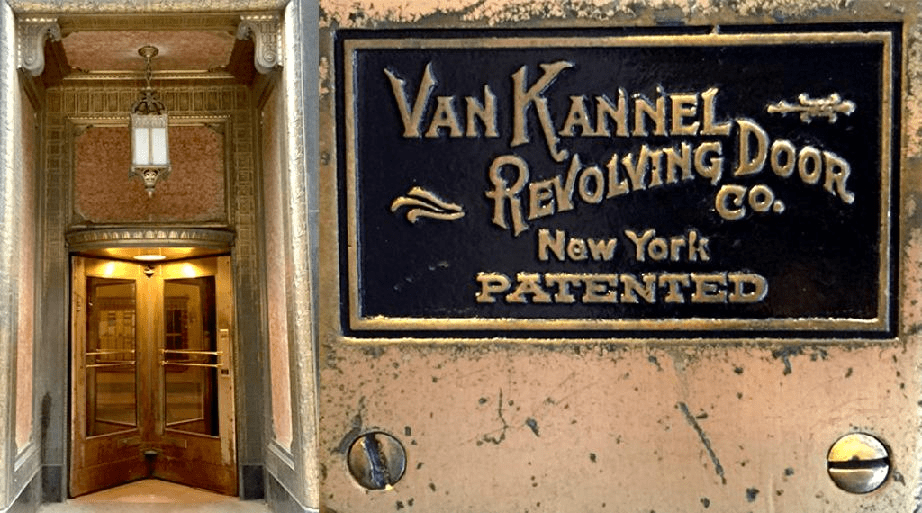

Thanks to Philadelphia native Theophilus Van Kannel, we can easily enter office buildings and shopping malls through revolving doors. He received the patent for his invention in 1888. His design offered many advantages over conventional doors: it fit snugly against the building, operated silently, and prevented dust, rain, or snow from getting inside. Society quickly recognized the value of this invention. Learn more about the development and design of revolving doors at iphiladelphia.
The Concept Behind Revolving Doors
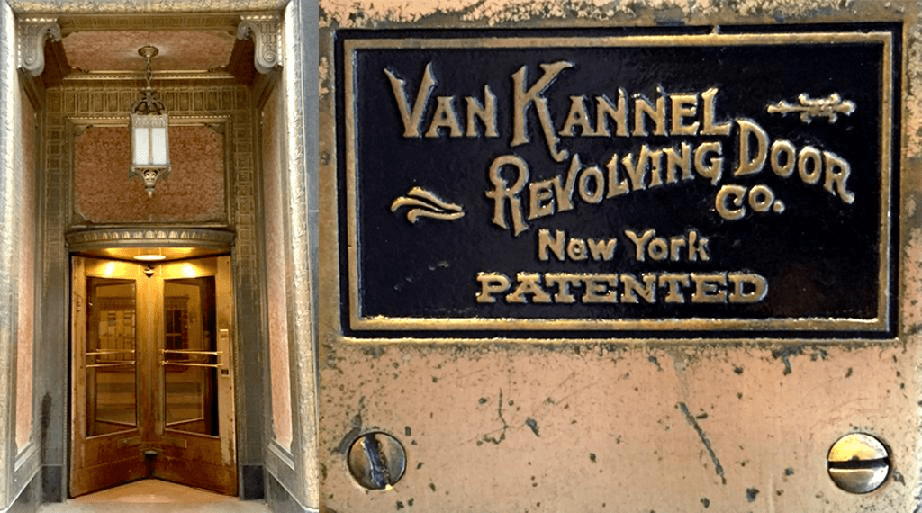
Revolving doors typically consist of three or four panels fixed to a central axis that rotates within a cylindrical enclosure. To enter a building, a person simply steps into the space between two panels and moves toward their desired exit, following the door’s rotation.
The development of revolving doors helped mitigate the “stack effect” or pressure differential caused by air currents in tall buildings. This design also allows a large number of people to enter and exit simultaneously. What’s more, these doors are energy-efficient. They prevent drafts and reduce heat loss or gain by creating an airlock effect, keeping indoor temperatures more consistent.
History of the Invention

The world’s first patent for a revolving cylinder with doors was granted to H. Bockhacker of Berlin in 1881. However, his design didn’t gain traction or widespread attention.
The trend of revolving doors truly began after Philadelphia native Theophilus Van Kannel secured his U.S. patent for the invention on August 7, 1888. He dubbed his creation “storm doors.” The patent application drawings depicted a three-section door:
- The sections were attached to a central axis and rotated in a circular motion.
- The doors were equipped with weather seals.
- One of the doors could be temporarily locked in place to allow for the passage of long objects.
Van Kannel described the design as silent and capable of isolating the building from street conditions. These doors would prevent noise, dust, rain, snow, and wind from entering the premises. Interestingly, Van Kannel never used the term “revolving doors” himself; that name for his invention came later, as its use became widespread.
In 1899, the world’s first wooden revolving door was installed at Rector’s restaurant in Times Square, Manhattan. The design quickly grew in popularity, leading the inventor to establish his own manufacturing company and gain recognition. In 1889, he was awarded the John Scott Legacy Medal by Philadelphia’s Franklin Institute for his contribution to society. In 2007, he was inducted into the National Inventors Hall of Fame.
Legend has it that Van Kannel developed revolving doors because he disliked opening conventional doors for women. However, there is no evidence to support this claim. Instead, his invention proved immensely practical and has become an indispensable part of daily life in the 21st century.
Modern Revolving Door Design

Modern revolving doors feature a central axis and three or four panels, often called wings. Their diameters can vary greatly, allowing large revolving doors to easily accommodate strollers and luggage. Sometimes, the interior circle is divided into several sections for convenience. The door wings may even incorporate a glass display case to showcase plants, mannequins, or works of art to visitors. Generally, the wings are made of glass so people can see each other and anticipate movements when passing through the door.
Revolving doors can be manual or automatic. Manual doors rotate as people push them to enter, and they are typically equipped with speed governors to prevent dangerously fast spinning. Automatic models use electric power supplied along the door’s perimeter or to the central axis. They also feature motion sensors for safety.
In countries with right-hand traffic, these doors usually rotate counter-clockwise. In countries with left-hand traffic, such as New Zealand and Australia, they rotate clockwise. In the UK, both variations can be found. The direction of rotation is determined by the door’s motion regulator mechanism or the orientation of the weather stripping.
It’s worth noting that this design has proven particularly useful for skyscrapers. Conventional doors in tall buildings can create a “chimney effect.” When opened, air is sucked in at high speed and then expelled through vents, or vice versa. This can make entering and exiting the building quite uncomfortable. Revolving doors prevent this effect because they don’t allow air to escape from within and create a safe air cushion. Additionally, they can be collapsed to move large items.
Thus, Theophilus Van Kannel’s invention from Philadelphia has served humanity for over a century, proving to be truly useful and important.